The next morning (as all mornings on this trip) began at 6. Up and packed, after a quick shower. Down for breakfast, then get your bike ready to go. They had kept all the bikes locked up in a large room, so this part was easy, after you found your bike inside the room. We went over to the send-off area under a large tent in the Roberta Bondar Pavilion, next door to the hotel.
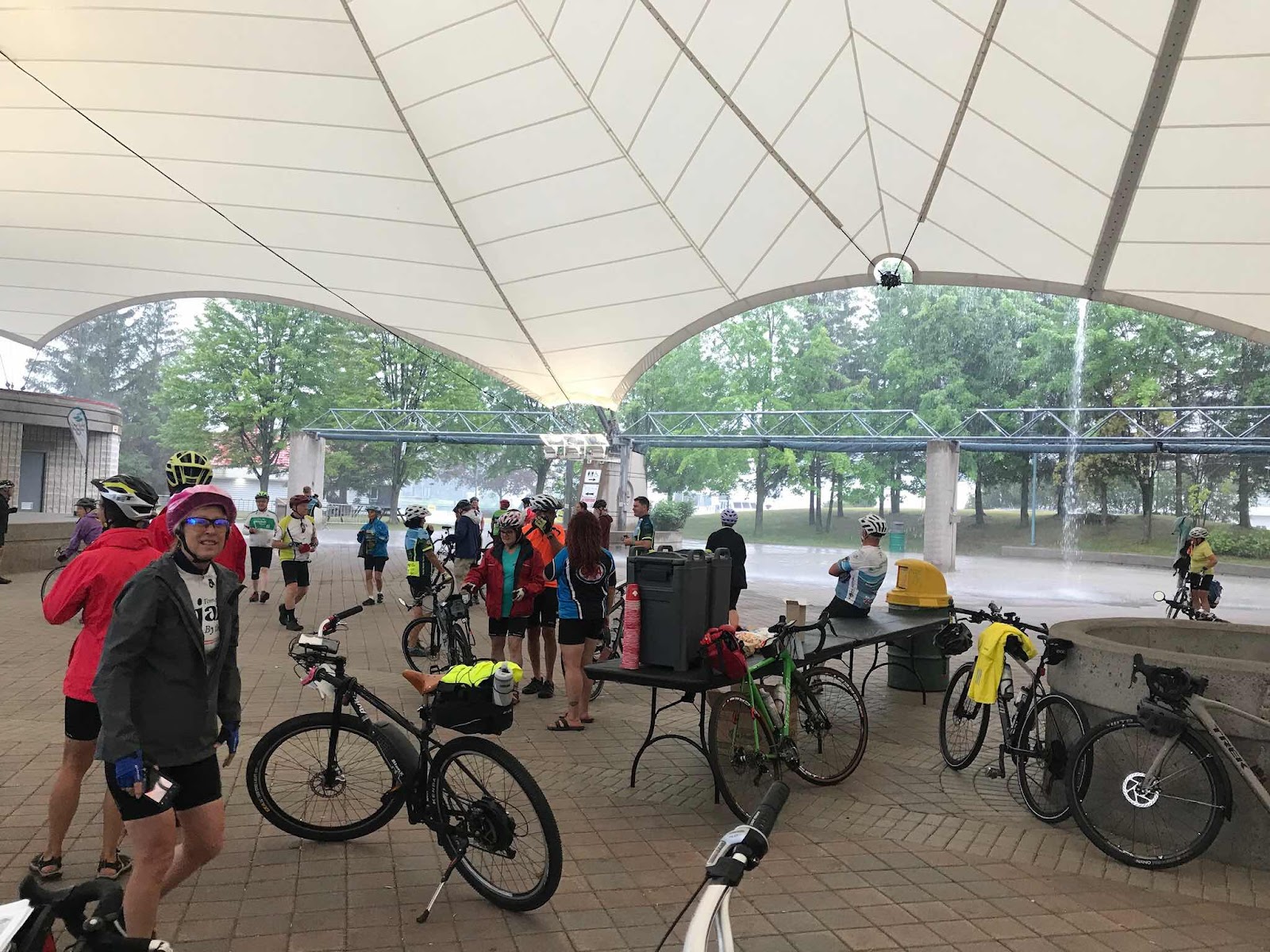
And it was good we were under the tent, as you can see in the second photo. We had the send-off ceremony, which included some drumming by the natives from the Ojibway of the Garden River Reserve. We think they must have been doing a rain song by mistake! FOrtunately, the rain stopped pretty soon, and it was just a heavy mist after that.
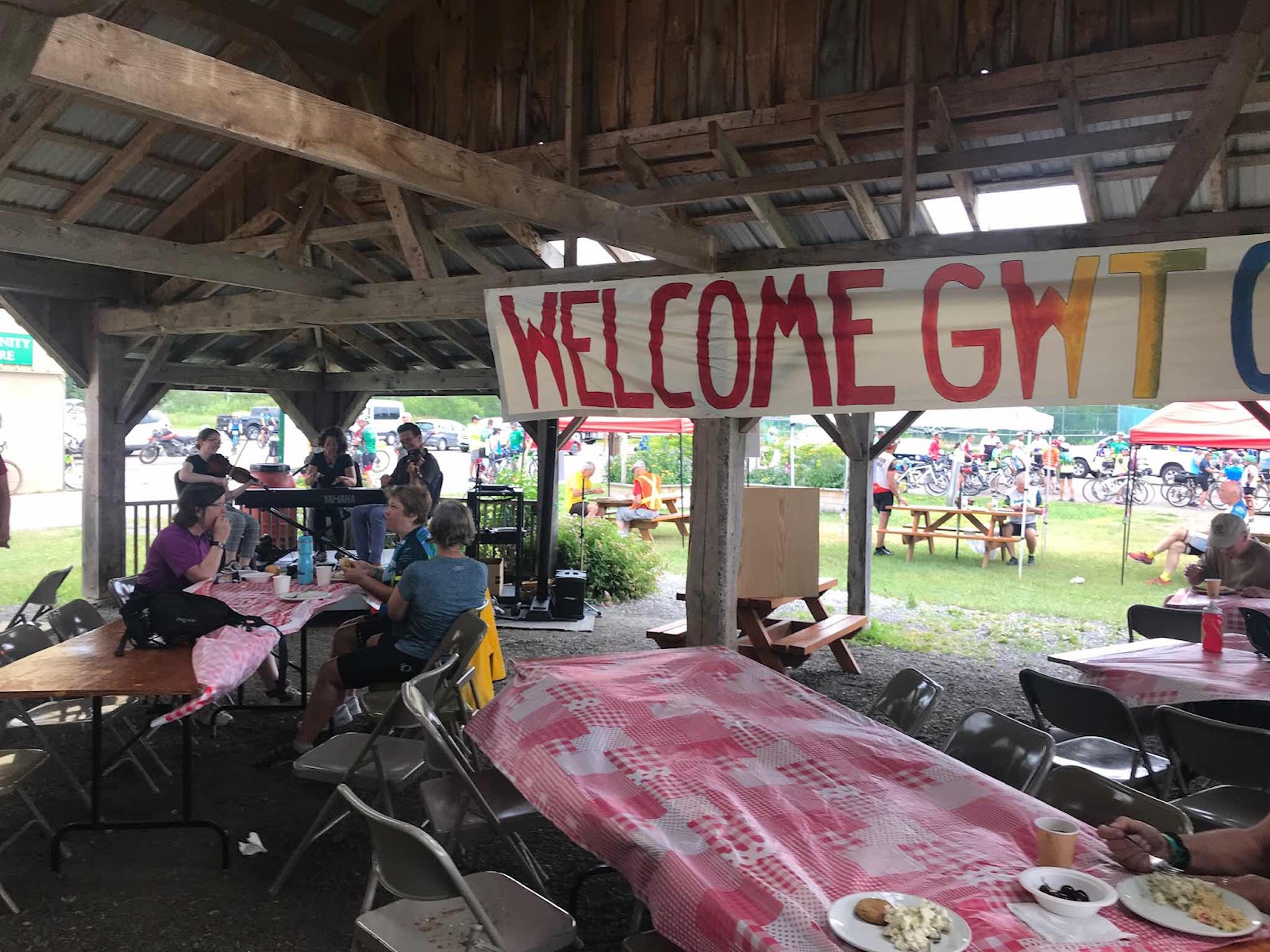
After a brief water and snack stop at a tourist trap called the Big Loonie, we proceeded on to our lunch at the Johnson Community Centre in Desbarats (pronounced “deborah”). This was amazing, and a sign that things were going to be all right, or better. They had lots of quite good food, and a fiddler and band to entertain us while there. It ws amazing, and much appreciated.
At this point, I was splitting from the others. Our friend, Phyllis, had recently moved from Hamilton to St. Joseph’s Island right nearby, and she had kindly offered to act as a tour guide for the afternoon. She cam and picked me (and the bike) up in her car, and we drove over to the island.
I was amazed to see the extent of the farmland that was there. And some of it was worked by Old-Order Mennonites. On St. Joseph’s Island, we saw horses and buggies. Phyllis told me that the Mennonites had been buying up land there, and ding a good job farming it. Her concern was that they did not send their children to the public school system, and consequently the school on the island was suffering.
And the island was a community, clearly. There was, aside from a marina, two libraries, and a children’s library; a medical centre/hospital with two doctors, four in-patient beds, and an ER; a grocery store and a pharmacy; a farmer’s market; and a firehall, township council (three, actually, since there were three townships). People knew each other, and kept in touch. There was even an historical site: an old fort dating from the War of 1812.
After a delightful three hours, I needed to get back, so Phyllis drove me to the Bruce Mines Campground—our overnight stay, and the first time for us in a tent. I got there before Jim, so set up the tent, and relaxed a bit. By then, the weather had cleared and was warm, so the bike became a drying rack for wet or damp clothes. Supper was provided that evening at the Canadian Legion, of course.
You have to remember that Bruce Mines is a town of about 600 people. We were about 160 people altogether. So they served what would be about a quarter of their population that evening, and did a damn good job of it. The food was actually better than at the hotel in the Soo the night before, and the service was friendly, if hectic. We were a loud crowd, There were speeches by the local MPP (Michael Mantha) as well as the mayor of Bruce Mines. We talked afterward to the MPP (an NDPer) and he pointed out that his riding comprised most of where we were going on this trip (it stops just short of Sudbury). He has over 30 communities and over 20 Indian reserves in his riding. And (he says) he loves his job.
That evening, there was a concert being held at the Gazebo by the marina. The group was actually pretty good, and the walk was not far. One of the interesting things in town was that they had placed bikes all along the main street: painted and secured, but perhaps there to welcome us. It was warming to us.


Again, we went to bed with the sun. Tomorrow was to come early, and we were tired. I had biked 59 km, and the others did about 73 km.

No comments:
Post a Comment